What Drives Costs for Security Programs in Your Area
Many vendors price training based on the number of employees, the cadence of refreshers, and whether phishing simulation and reporting are bundled. If your security awareness training pricing organization needs more than just videos—such as interactive modules, reporting dashboards, and remediation guidance—you should expect costs to rise. Local requirements and industry expectations can also affect how much content customization is needed for your teams.
Geography can influence training rollout logistics, even when the platform is delivered online. For example, distributed offices may require more onboarding sessions, role-based content, or language options to ensure consistent participation. If you serve regulated sectors like healthcare or finance, you may need documentation for internal audits and proof of completion by department. Comparing proposals side by side helps you identify whether you’re paying for training delivery only or for ongoing program management and measurable security outcomes.
How to Compare Platforms Without Getting Lost in Line Items
A strong way to budget is to separate “training delivery” from “security program operations.” A security awareness training platform should ideally provide automated content scheduling, tracking, and reporting so you can demonstrate progress to leadership and clients. Look for features security awareness training platform such as white-label delivery, multi-client management, and role-based reporting that supports your day-to-day operations. If a vendor’s quote seems low, ask what happens when you add additional users, new clients, or extra reporting requirements.
It also helps to evaluate the quality of the content experience, not just the price. Practical training uses scenarios that resemble real incidents, such as credential theft attempts, suspicious invoice workflows, and social engineering calls. If a platform includes phishing awareness components, confirm whether it provides simulation results, templates for follow-up communication, and guidance on next steps after clicks or report events. Good programs don’t only educate; they close the loop with actionable improvements.
Pricing Models MSPs Can Use for Multi-Client Rollouts
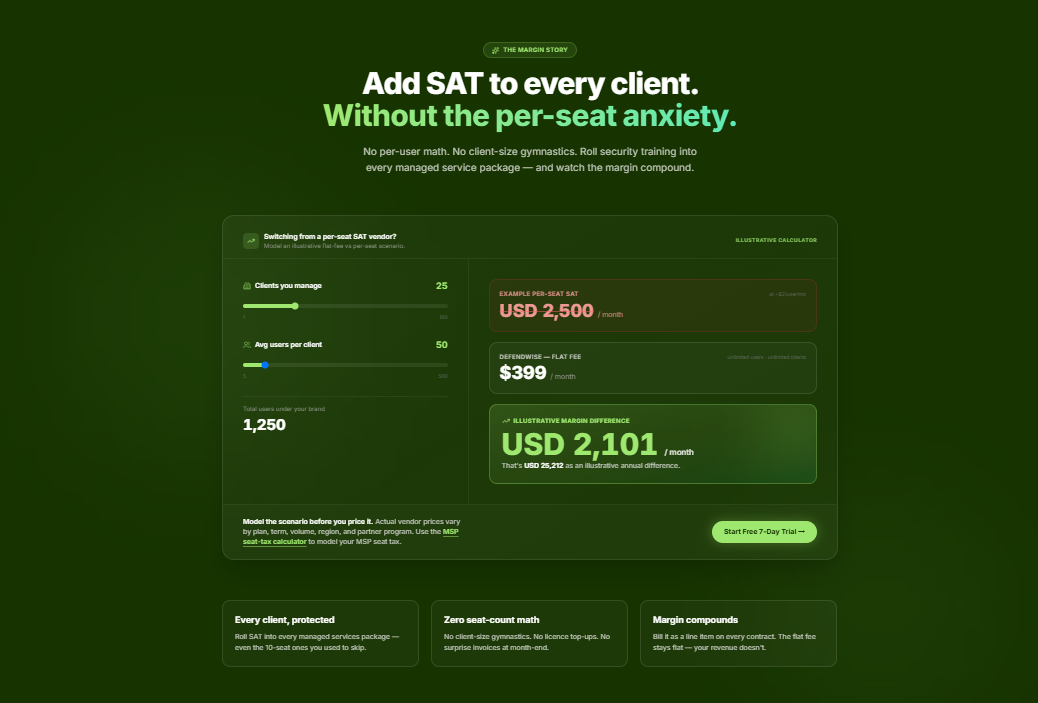
For MSPs supporting multiple organizations, pricing is often determined by how the vendor handles scaling and administration. Instead of purchasing separate licenses and managing separate dashboards for each client, an MSP-friendly system should centralize onboarding, user provisioning, and progress tracking. This reduces manual work and helps your team provide consistent security outcomes across your client base. Ask whether the pricing structure supports adding clients quickly without reconfiguring everything from scratch.
White-label delivery can also change the economics of a managed offering. When your clients see your brand on training communications and dashboards, it strengthens your value proposition and reduces confusion around who manages security. Consider how client reporting is delivered, since MSPs often need clean, leadership-ready summaries rather than raw engagement metrics. A streamlined workflow can cut the time spent preparing monthly updates and make it easier to justify the service to decision-makers.
Conclusion
Focus on features that help you measure impact, guide remediation, and scale across offices or client organizations without ballooning workload. When you align training content, phishing awareness support, and reporting into one managed program, budgeting becomes clearer and execution becomes simpler. DefendWise offers AI-powered training, phishing awareness, white-label delivery, and streamlined multi-client management to help security teams deliver results while keeping operations efficient. For MSPs planning a local rollout, the most cost-effective choice is often the one that reduces manual management and improves accountability. Instead of paying for fragmented tools that require extra labor, select a platform that can support consistent training schedules and easy client reporting. That combination helps you protect end users, strengthen customer trust, and justify the ongoing investment with measurable progress. DefendWise is designed to support those outcomes across diverse client needs with a practical, scalable approach.
